
Digital Marketing Trends 2026: A Complete Guide for PGDM Student
Introduction
Digital marketing is evolving faster than ever before. Every year brings new tools, changing customer experiences, and emerging platforms. As we navigate 2026, the modern marketing landscape is becoming increasingly AI-powered, data-driven, and hyper-customer-focused. For students pursuing a Post Graduate Diploma in Management (PGDM), digital marketing has moved from a standard elective to one of the most lucrative and essential career paths.
At SITASRM Institute of Management and Technology, learning classroom theory alone is no longer enough. Modern employers expect fresh management graduates to understand real-world digital execution, handle complex analytics, and leverage modern digital strategies on day one.
Whether you are specialising in marketing or taking a minor in business analytics, understanding the major digital marketing trends of 2026 will give you a decisive career advantage in today's corporate world.
Top Digital Marketing Trends 2026
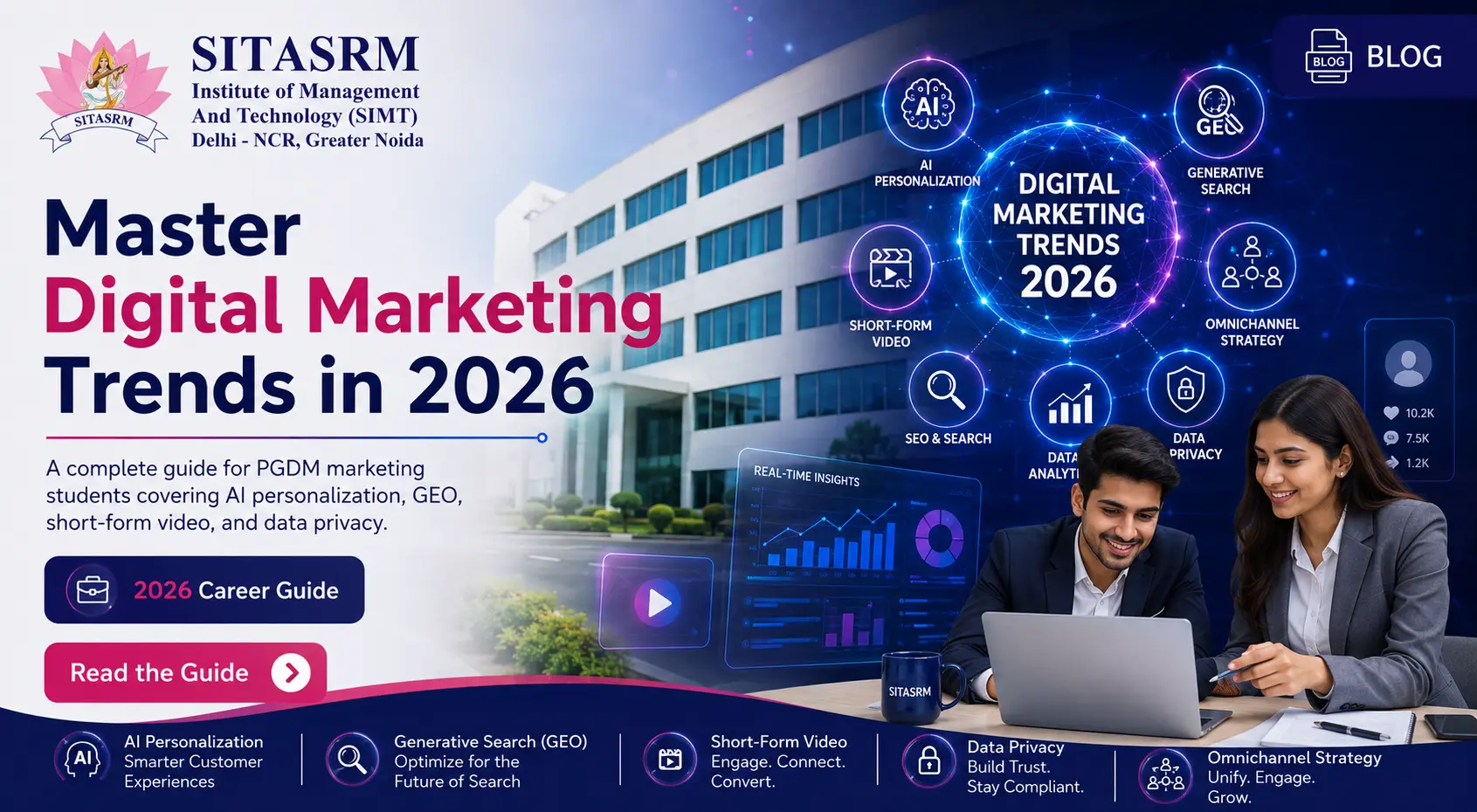
Artificial Intelligence, changing consumer behavior, and privacy-first algorithms continue to transform online engagement. Here are the key trends defining digital marketing in 2026 and how they connect to management education:
1. AI-Powered Hyper-Personalization
Artificial Intelligence is no longer just a buzzword—it is an operational standard. Marketers use AI algorithms for real-time, dynamic content personalization across every touchpoint:
-
Writing data-backed social media campaigns and ad copy.
-
Automated email marketing workflows and behavioral triggers.
-
Real-time product and content recommendations.
-
In-depth customer data analysis.
SITASRM Student Tip: AI tools assist human creativity; they do not replace strategic thinking. At SITASRM, electives like AI for Managers and Generative AI teach students how to manage AI tools effectively rather than relying on them blindly.
2. Generative Engine Optimization (GEO)
As search engines and AI platforms shift toward zero-click answers, traditional keyword stuffing is obsolete. Millions of users now query AI engines like Gemini and ChatGPT directly for answers. Generative Engine Optimization (GEO) focuses on optimizing digital content for authority, context, and brand citations so AI tools recommend your business.
3. Short-Form Video & Visual Marketing
In 2026, consumer attention spans favor bite-sized visual content over lengthy text. Mastering platforms like YouTube Shorts, Instagram Reels, and LinkedIn Video is essential for high brand engagement. PGDM marketing majors must build practical experience creating short-form promotional content, visual storytelling, and video ad campaigns.
4. Omnichannel & Predictive Analytics
Modern consumers switch effortlessly between channels—from social platforms to websites, emails, mobile apps, and physical stores. Real-time data attribution allows marketers to map these complex user journeys and predict consumer intent. Understanding how integrated marketing communications (IMC) and analytics work together is a core skill taught in the SITASRM PGDM curriculum.
5. First-Party and Zero-Party Data Focus
With stricter data privacy regulations and the deprecation of third-party tracking, consented customer data is critical:
-
Zero-Party Data: Information customers intentionally share (interactive surveys, feedback forms, preference centers).
-
First-Party Data: Information collected directly from brand interactions (website visits, app activity, email engagement).
Capturing high-accuracy, user-consented data enables ethical and highly targeted marketing strategies.
6. Smarter, Intent-Driven SEO
Search Engine Optimization has evolved from pure keyword targeting to intent-driven user experience. Modern ranking factors prioritize:
-
Technical performance and fast mobile responsiveness.
-
Strong internal link structures and authoritative backlinks.
-
High-value, helpful content aligned with exact search intent.
How SITASRM Prepares Students for Digital Marketing in 2026
At SITASRM Institute of Management and Technology (SIMT), management education is designed around an AI-integrated and industry-driven curriculum. Here is how wequips PGDM students to lead in the digital era:
-
Dual Specialization Flexibility: Students can pursue a Major in Marketing combined with Minors in Business Analytics, HR, or Strategy across 6 trimesters (108 credits).
-
Industry-Relevant Electives: Practical coursework covers Digital Marketing, Brand Management, Social Media Marketing, Advertising & IMC, and Consumer Behaviour.
-
Multidisciplinary Action Project (MAP): A capstone experience where students solve real-world corporate and digital marketing challenges through collaborative problem-solving.
-
Practical Experiential Learning: Hands-on experience through case studies, tech-empowered labs, summer internships, and continuous corporate interaction.
Essential Digital Skills to Build During Your PGDM
To stand out during corporate placements, every marketing aspirant should develop these practical capabilities:
| Marketing Domain | Key Skill to Master | Practical Application |
| Content & SEO | GEO & Search Intent Mapping | Writing brand blogs, optimizing for Generative AI engines. |
| Data Analytics | Customer Attribution & Web Analytics | Interpreting campaign metrics to optimize ad spend. |
| AI Integration | Prompt Engineering & Automation | Accelerating ad copywriting and customer workflow design. |
| Social Media | Video Storytelling & Community Engagement | Creating short-form videos for multi-platform engagement. |
Conclusion
The latest digital marketing trends 2026 are defined by artificial intelligence, data ethics, and authentic customer connection. By pursuing an industry-aligned management education at SITASRM Institute of Management and Technology, you do not just learn how to run campaigns—you gain the strategic, analytical, and leadership skills required to drive modern business growth.
Ready to launch your management career? Explore admissions for the 2026–28 PGDM programme on the official SIMT Admissions Portal.
Table Of Content
- Loading...
