
How Practical Learning in PGDM Program Prepares Corporate-Ready Leaders
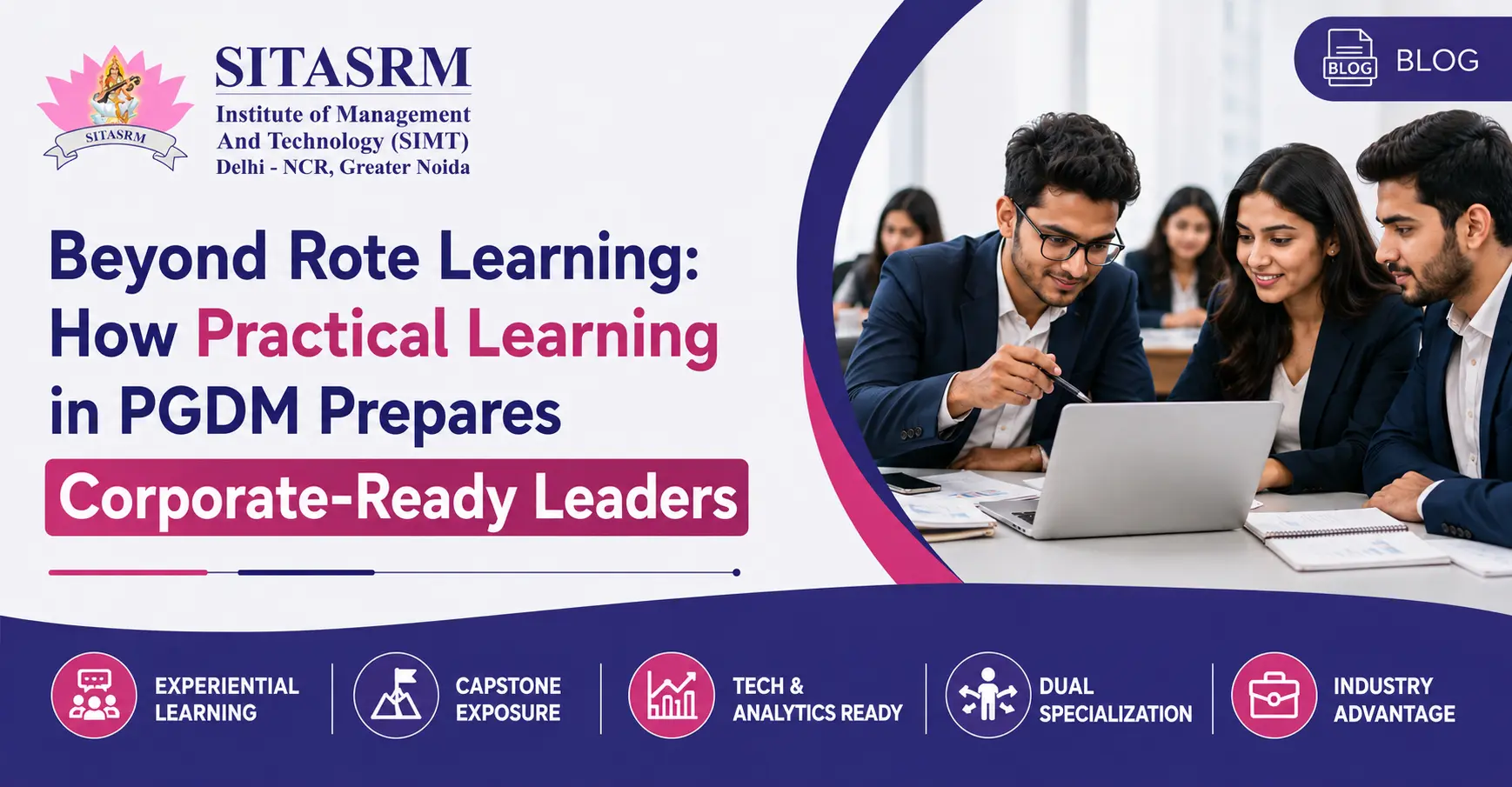
Choosing a management programme today is not simply about earning a qualification. Employers expect graduates to understand problems, communicate clearly, work with data, and make decisions. That is why practical learning in PGDM program matters for students who want classroom knowledge to translate into workplace capability. At SITASRM Institute of Management and Technology, Greater Noida, the two-year full-time PGDM is designed around conceptual foundations, industry relevance, experiential learning, analytics, leadership, and professional development.
Why Practical Learning in PGDM Program Matters
Management concepts become more useful when students apply them to realistic situations. Reading about marketing strategy differs from deciding how a company should respond to a changing customer segment. Studying finance differs from interpreting information before recommending a business decision.
A practical approach connects concepts with action. Discussions, presentations, projects, simulations, internships, and case-based activities can build problem-solving and decision-making abilities. SITASRM's learning approach includes case studies, group discussions, industry projects, practical simulations, teamwork, experiential learning, and continuous evaluation. Students are expected to participate rather than simply memorise information.
From Classroom Concepts to Business Situations
The value of a PGDM increases when students learn to think like managers. This reflects the SITASRM experiential learning approach, where application supports conceptual understanding.
This is where the PGDM industry integrated curriculum becomes relevant. The programme combines core management knowledge with specialisation flexibility, internships, projects, and experiential activities. Students can therefore work across different business contexts while strengthening their understanding of how functions connect.
Case-based learning is particularly useful here. PGDM case studies and simulations can place students in situations requiring analysis, discussion, and judgement. Simulations and group projects add another layer by encouraging students to communicate, collaborate, and defend their choices.
Learning Through Projects, Simulations and Collaboration
Practical learning in PGDM program is not limited to one classroom activity. It can develop through several connected experiences across the programme.
At SITASRM, students are expected to work on collaborative learning activities, industry projects, internships, and a Multidisciplinary Action Project (MAP). The MAP is designed as a capstone experience in which students integrate knowledge from different disciplines to address real business problems.
These activities matter because management roles require more than individual knowledge. Professionals must present ideas, consider viewpoints, handle feedback, analyse information, and move from a problem statement to a workable solution.
The institute also highlights industry exposure through internships and corporate projects. Such experiences can help students understand professional expectations, workplace communication, deadlines, and practical decision-making.
Building Skills for a Technology-Driven Business World
Modern managers increasingly work with digital platforms, analytics, automation, and artificial intelligence. Business education must prepare students to understand technology without losing management fundamentals.
SITASRM's PGDM includes an analytical focus covering areas such as Business Analytics, Machine Learning, and Cloud Computing. Its elective offerings can also include AI for Managers, Fintech, Generative AI, and Social Entrepreneurship.
This approach makes practical learning more relevant. Students can learn how data and digital tools support business decisions. The ability to interpret information, question assumptions, and communicate insights is useful across finance, marketing, HR, strategy, and consulting.
Dual Specialization Can Broaden Practical Exposure
Another important feature is the programme's major-minor structure. This supports the PGDM dual specialization Greater Noida students may seek when planning broader career options. Students can customise their academic path across Finance, Marketing, Business Analytics, HRM, or Entrepreneurship, while the site also highlights specialisation flexibility.
This matters because business problems often cross functional boundaries. A student interested in marketing and analytics, for example, can explore customer behaviour from both creative and data-oriented perspectives. Someone combining finance and strategy can examine business performance alongside long-term decisions.
Preparing for the Workplace, Not Just the Examination
Practical learning in PGDM program also changes how students think about performance. A strong manager needs more than correct answers in an examination. They need to explain a recommendation, work with a team, respond to changing information, and take responsibility for decisions.
SITASRM's training and placement approach focuses on experiential learning, industry-aligned education, live projects, internships, and professional skill development. The institute also highlights leadership and employability training as part of its PGDM offering.
These experiences can help students demonstrate skills beyond academic marks and discuss practical examples during interviews.
Why Greater Noida Adds to the Learning Experience
Location can also influence management education. For students seeking skill based management education Delhi NCR, the region offers a broad academic and corporate ecosystem.
Greater Noida sits within the wider Delhi NCR business and education ecosystem, giving students access to a region with diverse corporate and professional opportunities. The benefit is having an environment where internships, industry interactions, events, projects, and professional networking can become part of the learning journey.
Conclusion
A management degree becomes more valuable when students can use what they learn. Practical learning in PGDM program helps connect theory with business situations, teamwork, technology, projects, internships, and decision-making. At SITASRM Institute of Management and Technology, these elements form a central part of the PGDM learning approach.
For graduates planning a management career, the right question is not only what subjects a programme teaches. It is also how those subjects are experienced, applied, discussed, tested, and connected to real business challenges. That is where practical learning in PGDM program can make the difference between knowing a concept and knowing how to use it.
Table Of Content
- Loading...
