
Situational Leadership Theory: Ultimate PGDM Career Booster
Introduction
Leadership is no longer about giving orders; successful leaders are those who can manage their leadership style as per the needs of the team members. Different team members require different levels of guidance & support. It depends on confidence, skill, and experience. This is where Situational Leadership becomes an important concept.
It is important to understand Situational Leadership Theory for PGDM students. Nowadays, workplaces demand leaders who can adapt to changes based on situations. Whether managing academic projects, future corporate teams, or flexible leadership helps improve team performance.
What is Situational Leadership Theory?
In the late 1960s, Paul Hersey and Kin Blanchard developed a Situational Leadership Theory model. The theory says, “there is no single best leadership style." Instead, competence, commitment, and readiness are the factors leaders adjust their behaviour to.
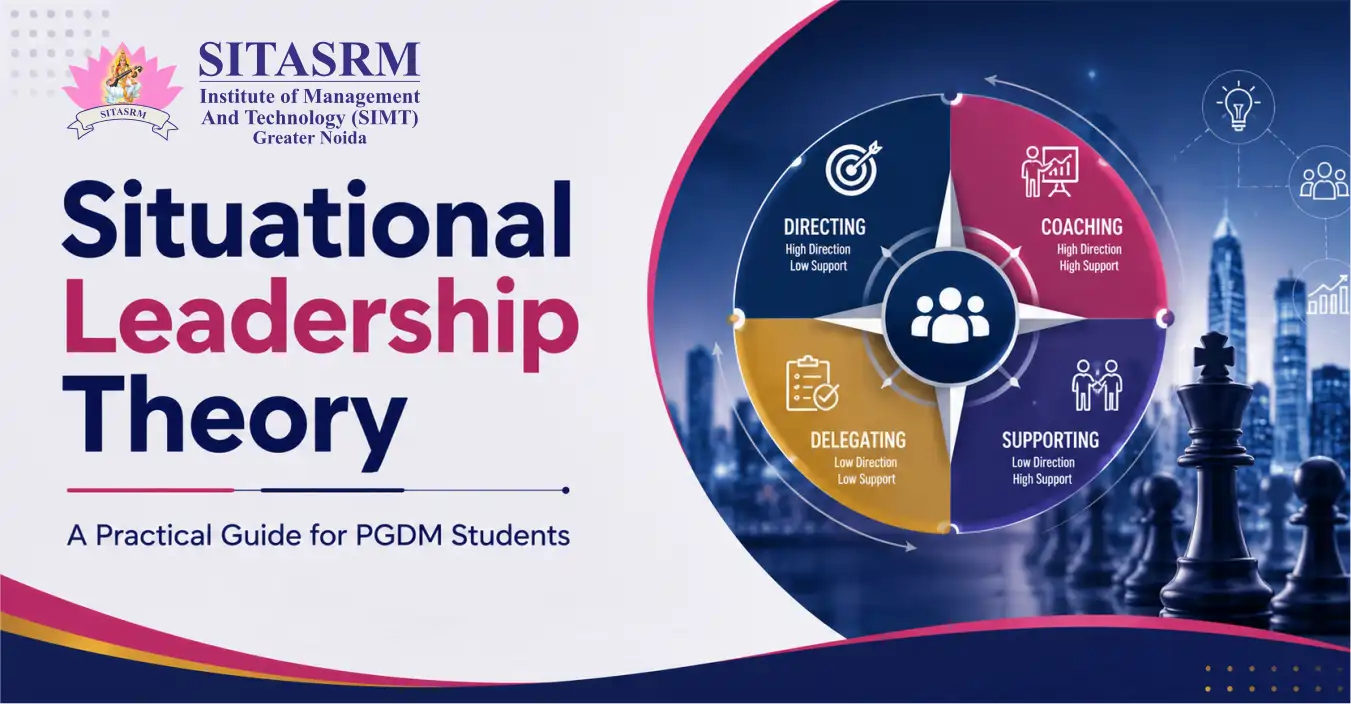
Different people require different leadership. It depends on skills, motivation, and confidence. Situational Leadership depends on four primary leadership styles. Let us discuss each with examples:
1. Directing (S1) - Leadership provides clear guidance & monitor task completion. The best way a leader makes decisions & guides is communication. It is best suited for:
-
Fresh interns
-
New employees
-
Team members with limited experience
Example: A newly hired employee needs detailed instructions. The manager explains every task, monitors progress, and then provides immediate tasks.
2. Coaching (S2) – Here, Leaders provides clear instructions while encouraging feedback, discussion , and motivation. Two-way communication becomes effective. It is best suited for:
-
Employees learning new skills
-
Teams needs support & motivation
Example: A marketing intern understands the company’s project but still struggles to close deals.
3. Supporting (S3) – The leader shares decision-making responsibilities. Also, it focuses on building confidence. Employees do have the required skills but may lack confidence. It is best suited for:
-
Independent team members
-
Experienced employees
Example: A project leader supports the employee emotionally. He also involves them in decision-making whenever needed.
4. Delegating (S4) - Delegating is used when a leader gives less supervision & trusts employees to complete tasks on their own. Team members possess both competence and commitment. It is best suited for:
-
Self-motivated employees
-
Highly experienced professionals
Example: A senior software developer manages project delivery. On the other hand, manager focuses on strategic planning.
Employee Development Levels
Here, we have divided development level, characteristics, and preferred leadership style:
|
Development Table |
Characteristics |
Preferred Leadership Style |
|
D1 |
Low competence, high enthusiasm |
Directing |
|
D2 |
Some competence, low confidence |
Coaching |
|
D3 |
High competence, variable commitment |
Supporting |
|
D4 |
High competence, high commitment |
Delegating |
Why is Situational Leadership important for PGDM students?
Situational Leadership theory provides many advantages to PGDM Students. They:
-
Improves Decision-making ability
-
Develops leadership skills
-
Increases adaptability in a dynamic business environment
-
Improves confidence & communication skills
-
Prepares students for workplace challenges
-
Makes project management capability strong
These skills are very important to recruiters across industries.
Real-Life Applications
Here, we have shared some real-life applications for situational leadership theory:
-
Human Resource Management
-
Project management
-
Marketing
-
Sales Leadership
-
Manufacturing
-
Educational institutions
-
Startups & manufacturing
-
IT companies
-
Healthcare organizations
Professionals switch between leadership styles depending on their performance and needs.
Advantages of Situational Leadership Theory
Some major benefits are the following:
-
Flexibility – It means leadership should change according to situations
-
Better Team Performance – It matches leadership style with employee needs, which increases job satisfaction.
-
Higher motivation – This improves employees' confidence & engagement
-
Stronger Relationship – Professionals appreciate leaders who understand challenges & feedback.
-
Time-consuming – Shifting responsibility to different employees.
Not suitable for every situation – Leaders may need to make quick decisions in any emergency.
Tips for PGDM Students to Practice Situational Leadership
Students can enhance situational leadership skills through given points:
-
Observe teammates before giving any responsibility.
-
Adapt communication according to the individual’s experience.
-
Identify a person's strengths and weaknesses
-
Encourage open discussion and feedback
-
Learn to trust capable team members
-
Use internships & live projects as opportunities to build flexibility and leadership skills.
These skills will make students more professional even before entering the corporate world.
Conclusion
Situational leadership is one of the most practical leadership styles. It promotes adaptive leadership instead of following rigid management practices. Managers can improve both team performance and individual development by selecting the correct leadership style. For PGDM students, mastering Situational Leadership Theory provides a strong foundation for leadership roles.
At SITASRM, we don’t just equip you with curriculum studies; we build you for an exciting future. Students will be able to manage different skills, such as internships, managing projects, and fitting in corporate teams. This motivates team members & supports long-term professional success. Situational Leadership needs leaders with emotional intelligence, flexibility, and empathy.
Table Of Content
- Loading...
