
Why Strategic Management Basics Matter in a Modern PGDM Program
Introduction
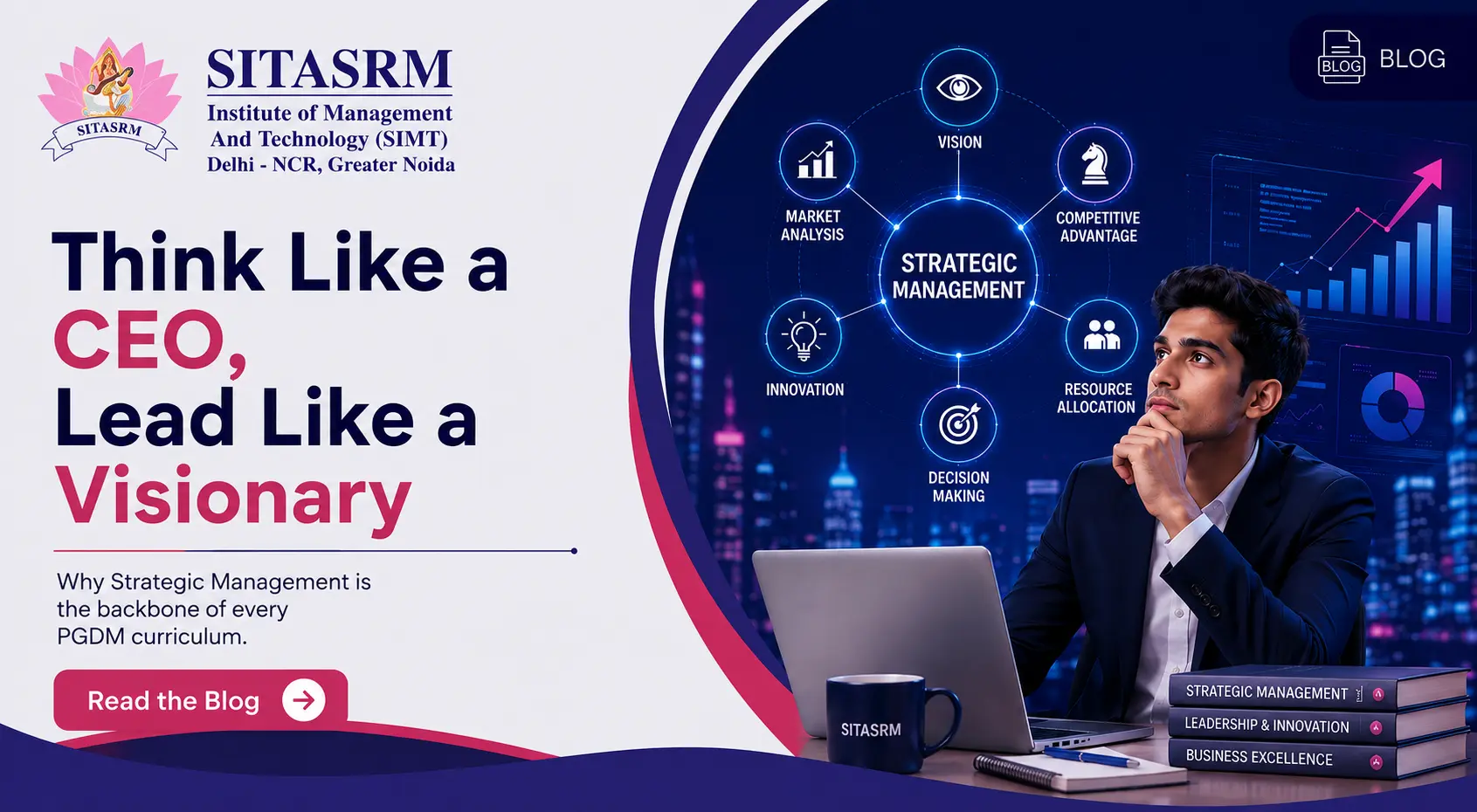
Strategic management is the glue that holds PGDM together. It trains you to stop thinking like a junior employee and start thinking like a CEO. Strategic management teaches you how to actually win the game. The first step towards becoming a visionary leader is developing the right PGDM skills.
A postgraduate diploma in Management (PGDM) helps to develop a mindset that prioritises analytical depth and forward-looking strategy. When students join a PGDM programme, they expect to learn finance, marketing, HR, and business analytics.
The only subject that connects the dots between all of them is Strategic Management. To know in detail what strategic management basics are, its several core elements, why strategic management basics matter and some real-life examples, students must go through the article below.
What are Strategic Management basics?
Strategic Management basics help students think beyond daily business activities. Students learn how companies make long-term decisions, tackle competitors, and achieve sustainable growth.
It is an essential business function that enables organisations to define and execute strategies to meet goals and outperform competitors. It unites isolated business concepts (like finance and marketing) into a single “big picture”.
In short, strategic management is the process of deciding where a business will go and how it will get there.
Why Does Strategic Management Matter?
Strategic management ensures that all aspects of a business are aligned with its vision and objectives and competitive advantage. Let us discuss some core elements:
-
The Big Picture - It teaches students to look at the bigger picture instead of only at their own department. It makes them learn how all business parts work as one team.
-
Real-World Problem Solving – It shows how to handle tough business crises using real-life case studies. This helps students to design and find new and the finest solutions to these types of tough problems.
-
Smart Choices – For daily work, it teaches tools like SWOT (Strengths, Weaknesses, Opportunities, and Threats). It helps businesses understand their current position before making strategic decisions.
-
Networking Opportunities – Students will get the opportunities to network with a wide range of leaders in the field and alumni via this programme. It also provides resources that can be important for future collaboration and your career.
-
Vision and Mission – Students learn the difference: vision is the company’s future dream, whereas mission is the company’s present purpose. Both provide direction for business growth.
Students learn how successful businesses grow and adapt to changing market conditions by understanding the basics of strategic management.
Strategic Management: The Backbone of Every PGDM Curriculum?
Strategic management plays a key role in every PGDM curriculum. It brings together knowledge from different business functions. Let us explore them:
1. Connects every business function: Finance, HR, management and IT do not work alone. Students learn how these departments collaborate to achieve common organization goals. Such as:
-
HR hires talented employees
-
Finance manages investment
-
Marketing attracts customers
-
Operations ensures smooth productions
2. Improve Decision-making: Managers make many decisions throughout their career. Strategic management makes students know how to:
-
Understand situation
-
Predict possible outcomes
-
Compare different opinions
-
Choose the best solutions
3. Helps understand the business: In the business world, change is a part of daily life. It includes changes like:
-
Economic changes
-
New technologies
-
Customer demands
-
Government regulations
Through strategic management, students must learn to consider these factors before making important decisions.
4. Build leadership skills: Leaders should think beyond short-term tasks. They must:
-
Inspire teams
-
Make informed decisions
-
Solve business problems
-
Take calculated risks
-
Plan for the future
Strategic management motivates students to build these leadership qualities.
Real-life Examples of Strategic Management
Let us take the example of two smartphone companies:
The first company has been selling the same product for years without understanding customers' needs & the changing world.
The second company goes with market trends, introduces innovative features, and fulfils customer demands.
Which company is more likely to grow?
As expected, the second one.
This is strategic management in action. Companies that regularly innovate, plan, and adapt are far more likely to succeed in competitive markets.
Skills develop through strategic management
Students develop several important professional skills by learning the Strategic Management Basics. Several of them are:
-
Decision making
-
Leadership
-
Critical Thinking
-
Risk management
-
Team management
-
Problem solving
-
Strategic planning
A strong understanding of strategic management basics helps candidates stand out during interviews and throughout their careers.
Conclusion
A PGDM is much more than learning individual business functions – it’s more about understanding how companies grow, compete and succeed in an ever-changing world. Strategic Management basics form the backbone of every PGDM curriculum.
By learning the strategic management basics, students learn how to analyze business situations, make informed decision, and lead organisations with confidence. It helps in improving academic performance. Also, prepare students for successful career in today’s corporate world.
Table Of Content
- Loading...
