
PGDM Skills for Strategic Thinking: How to Master Modern Business Leadership
.jpg)
Introduction
Developing the right PGDM skills for strategic thinking is the first step toward becoming a visionary leader in today’s volatile global economy. In an era defined by rapid digital transformation and shifting market dynamics, the ability to look beyond immediate tasks and envision long-term success is what separates a manager from a true leader. While many academic programs offer foundational knowledge, a Post Graduate Diploma in Management (PGDM) is uniquely designed to foster a mindset that prioritises analytical depth and forward-looking strategy.
The demand for professionals who possess strategic leadership skills has never been higher. Employers are no longer looking for candidates who can simply follow instructions; they want architects of growth who can navigate complexity with confidence. This journey begins with understanding how a specialised curriculum transforms a student’s cognitive approach to business challenges.
Practical vs Theoretical Management Education: The PGDM Edge
One of the most significant advantages of a PGDM program is the balance it strikes between practical and theoretical management education. Traditional degrees often lean heavily on textbooks and historical theories that may not reflect the current pulse of the industry. However, the PGDM framework is autonomous, allowing institutes to update their syllabi in real-time to include emerging trends like AI-driven analytics, green supply chains, and ESG (Environmental, Social, and Governance) factors.
Choosing a program that prioritises practical vs theoretical management education ensures that students are not just learning "what" a strategy is, but "how" to implement it under pressure. This hands-on approach is essential for sharpening PGDM skills for strategic thinking, as it forces students to move away from rote memorisation and toward active problem-solving. By engaging with industry experts and live projects, learners bridge the gap between classroom concepts and boardroom realities.
Why Case Study-Based Learning in India is Essential for Success
The hallmark of a premier management institute is its reliance on case study-based learning in India. This pedagogical tool is the primary engine behind the development of high-level analytical capabilities. Instead of listening to a lecture on market entry, students are handed a 20-page document detailing a real Indian startup's struggle to scale. They must analyse the data, identify the bottlenecks, and defend their solutions.
Through case study-based learning, students are exposed to diverse business scenarios—from FMCG distribution hurdles in rural markets to the scaling of fintech giants in urban hubs. This immersive experience is where PGDM skills for strategic thinking are truly forged. It teaches students to look for patterns, anticipate competitor moves, and understand the nuances of the Indian consumer psyche.
Furthermore, case study-based learning encourages collaborative thinking. When students from different backgrounds debate a case, they learn to appreciate multiple perspectives—a core component of strategic leadership skills. This diversity of thought is what leads to more robust and innovative business strategies.
Developing Strategic Leadership Skills for the 2026 Workforce
As we look toward the business landscape of 2026, strategic leadership skills have evolved to include emotional intelligence, cultural agility, and technological fluency. A PGDM program doesn't just teach you how to read a balance sheet; it teaches you how to lead the people behind those numbers.
To develop these strategic leadership skills, PGDM students participate in leadership labs, simulation games, and mentorship programs. These activities simulate the high-stakes environment of executive decision-making. By refining your PGDM skills for strategic thinking in these controlled environments, you gain the "muscle memory" needed to stay calm and rational when real-world crises hit.
How PGDM Curriculums Build Analytical Frameworks
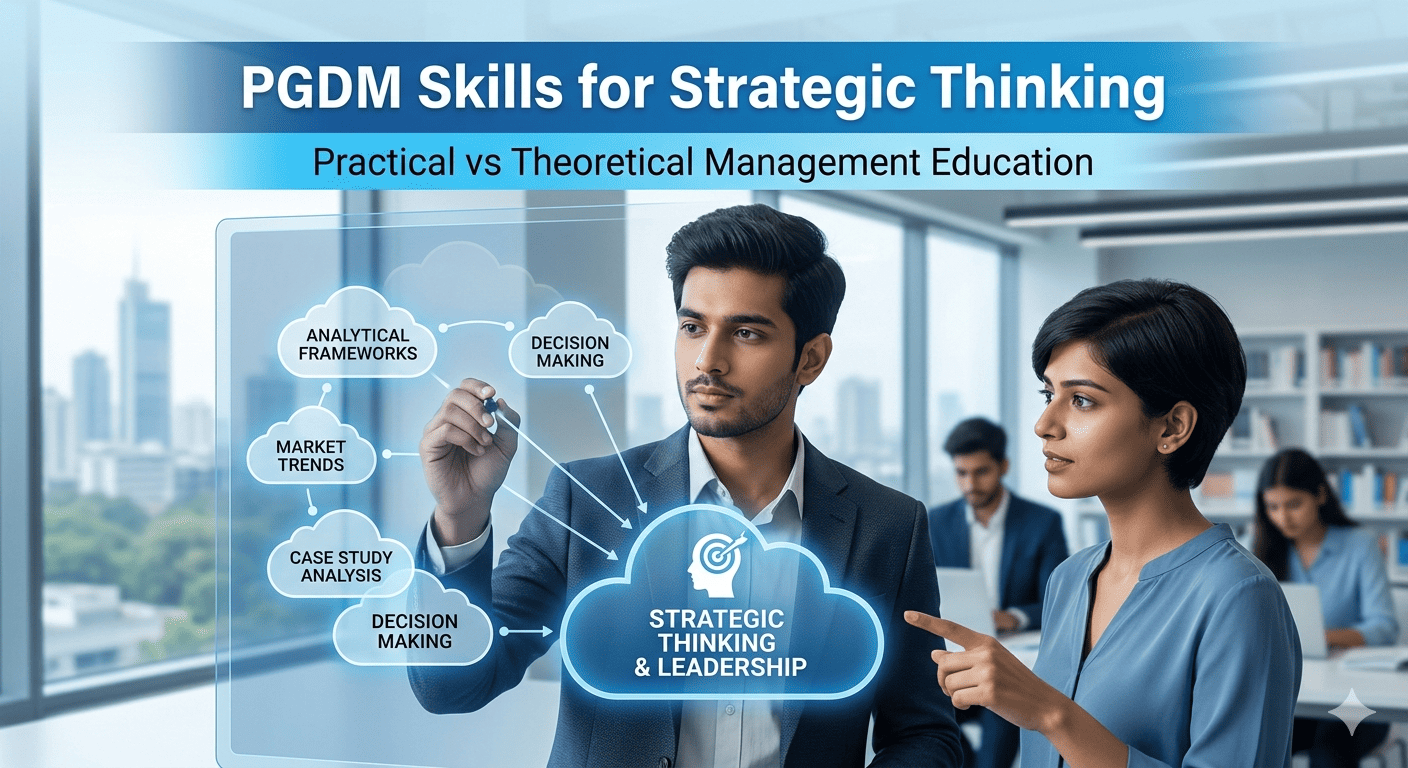
A core part of mastering PGDM skills for strategic thinking involves learning specific analytical frameworks. Whether it’s SWOT, PESTLE, or the Blue Ocean Strategy, these tools provide a structured way to look at a chaotic market. However, a PGDM goes further by teaching students how to customize these frameworks for specific industry needs.
For instance, understanding the difference between practical vs theoretical management education becomes clear when you apply Michael Porter’s Five Forces to a modern e-commerce marketplace. The theory provides the skeleton, but the practical application—considering the "burn rate," "customer acquisition cost," and "logistics infrastructure"—provides the flesh and blood of the strategy.
The Role of Industry Immersion in Strategic Growth
No amount of classroom time can replace the insights gained from direct industry interaction. Most top-tier PGDM programs include mandatory internships and corporate projects. These experiences are vital for testing your PGDM skills for strategic thinking in a live environment. When you are tasked with optimizing a supply chain or drafting a marketing plan for a real brand, the stakes are real, and the learning is permanent.
This immersion is also where you begin to network with professionals who already possess advanced strategic leadership skills. Observing how successful CEOs make decisions provides a "silent mentorship" that is invaluable. It reinforces the importance of practical vs theoretical management education, showing that while theory provides the map, practice provides the compass.
Navigating Complexity with PGDM Skills for Strategic Thinking
Strategic thinking is essentially the art of making choices today that create a better tomorrow. This requires a deep understanding of data. In the PGDM syllabus, data science and business intelligence are integrated into every module. By utilizing case study based learning India, students learn to use data to validate their strategic hunches.
When you can back up a "gut feeling" with a data-driven model, your strategic leadership skills become much more persuasive to stakeholders. This intersection of intuition and information is the "sweet spot" of PGDM skills for strategic thinking. It allows you to pivot your business model before a trend becomes a threat, ensuring long-term sustainability.
Conclusion: Preparing for the Future of Business
In conclusion, the journey to becoming a corporate leader is paved with the rigorous application of PGDM skills for strategic thinking. By choosing a program that emphasizes practical vs theoretical management education, you ensure that your knowledge remains relevant and actionable. Through the deep dive of case study based learning India, you sharpen the analytical tools necessary to dissect complex problems and find innovative solutions.
Ultimately, the goal of any high-quality management program is to produce individuals who possess not just technical expertise, but also the strategic leadership skills required to inspire teams and drive organizational change. As you embark on your PGDM journey, remember that every case study, every project, and every debate is an opportunity to refine your vision and build a legacy of strategic excellence.
Table Of Content
- Loading...
